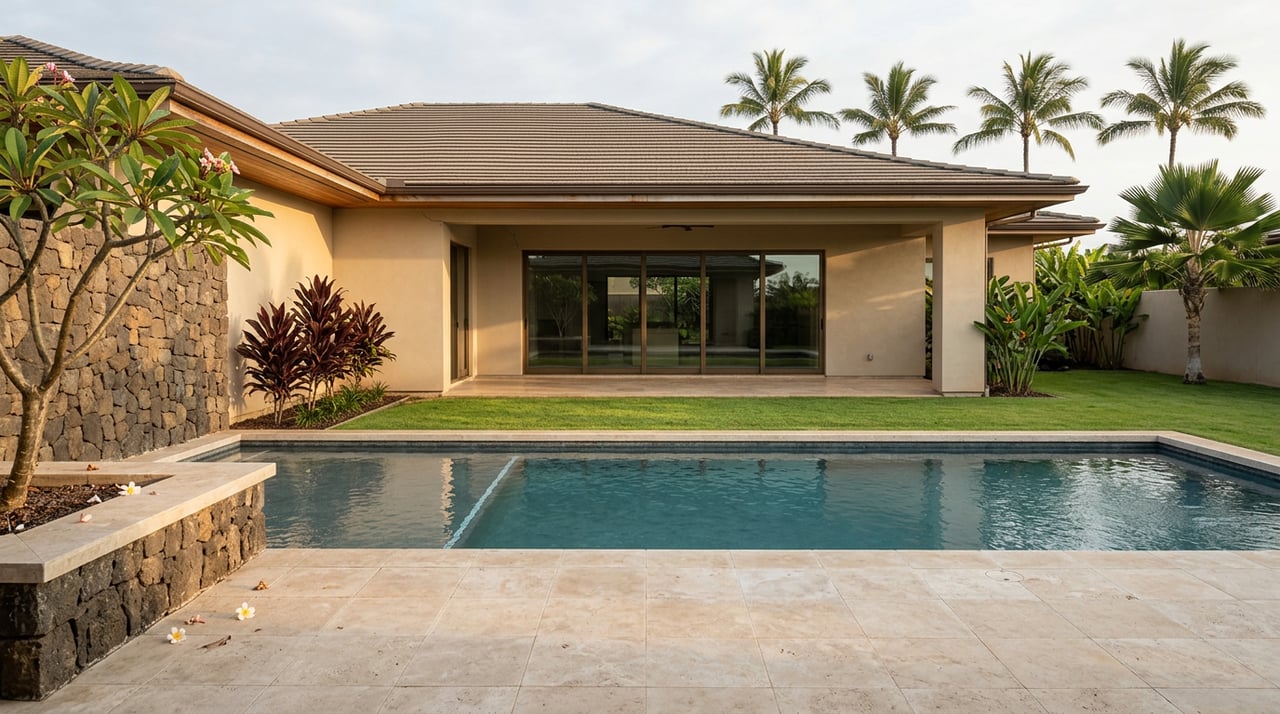
Buyers who fall for a home inside Kohanaiki's gates usually don't find out what it actually costs until an offer is already on the table. The Club Disclosure Statement, the document that spells out initiation fees, annual dues, and the membership obligation tied to every property inside the community, isn't handed over during a showing or even during early negotiations. It surfaces once a serious offer is in motion. By the time a buyer sees the real number, they've already decided this is the house.
That timing isn't an accident of paperwork. It's a structural feature of how private club communities like Kohanaiki are built to sell, and it's the first thing anyone comparing this market against a portal search needs to understand before they get further along than they meant to.
The Median That Isn't Measuring the Club
Search "Kohanaiki real estate" on a national portal and you'll land on a median sale price hovering around $1,125,000, down 24.4% year over year as of February 2026. If you're comparing that number to the eight-figure estates you've seen photographed on Kohanaiki's own site, something doesn't add up. It shouldn't. The name "Kohanaiki" gets applied to at least three different places on this stretch of coast, and only one of them is the gated club.
There's Kaiminani, a quiet residential pocket a short drive inland with roughly 238 residents by county-level counts, known for goats wandering into yards and Nextdoor posts about elementary school fundraisers. There's Kohanaiki Homestead, a separate cul-de-sac neighborhood northeast of Holualoa with closer to 9,500 residents, entirely unrelated to the golf course and beach club. And there's the actual private community: 450 oceanfront acres, a mile and a half of shoreline, a Rees Jones golf course, and a membership roster that decides who gets in.
Portal aggregators tend to lump these together under one geographic label, which is how a headline median built substantially from homes outside the gates ends up standing in for a market where individual residences closed at an average of $9.68 million in 2025. If you're pricing your search off that portal number, you're pricing off the wrong neighborhood.
What Actually Closed Inside the Gates in 2025
The full picture from actual club transactions looks nothing like the portal snapshot. Twenty properties closed inside Kohanaiki in 2025: eight residences and twelve condos.
| Metric | Full-Year 2025 (Closed Club Sales) |
|---|---|
| Residences closed | 8, averaging $9,680,000 |
| Condos closed | 12, averaging $4,986,666 |
| Average price per square foot | $1,984 |
| Average days on market | 79 |
| Sale-to-list ratio | 94.85% |
That sale-to-list ratio matters more than it looks. At nearly 95%, sellers inside the club were getting almost exactly what they asked for, which tells you the buyer pool here isn't haggling the way a broader Kailua-Kona market might. It also tells you the 79-day average time on market is closer to a normal transaction runway for the product than a sign of hesitation. Compare that against April 2026, when one residence sold for $21 million after sitting 419 days and closing at 89.3% of its most recent list price. That single sale is the outlier that should make any buyer pause before assuming every Kohanaiki listing moves in under three months. Some do. Some sit for over a year even at trophy pricing.
The Home Price Is the Entry Ticket, Not the Total
Every property owner at Kohanaiki is required to join the Club at Kohanaiki as a condition of ownership. There's only one membership tier, no lesser package, no way to buy the real estate and skip the club. As of 2026, initiation fees at Kohanaiki run in the high six to low seven figures, with annual dues in the mid five figures on top of that. Homeowners association dues are separate again, layered on top of both.
For buyers who aren't ready to commit to full ownership, there's a lower-friction entry point: the Hale Club, built around 17 member-owned Hale units on the property, each offering 45 nights a year of stay and full club access. It's how a lot of prospective members test the community before they buy land or a finished home.
None of this changes the sale price on a listing sheet. It changes the total cost of getting the keys, and it's the reason the Club Disclosure Statement doesn't move until an offer does. The club wants a buyer committed to the property before they see the full financial picture of the membership that comes with it. That's not a criticism of how Kohanaiki runs its business. It's simply the order of operations a buyer needs to plan around, and it's worth requesting the current Disclosure Statement as early in your search as the club will allow, not after you've already fallen for a specific house.
Where Kohanaiki Sits Next to Kūkiʻo
Kohanaiki gets compared constantly to Kūkiʻo, its neighbor up the coast, and the two clubs solve for different households. Both require mandatory membership at time of purchase. As of 2026, both run high six to low seven figures for initiation with annual dues in the mid five figures, and Kūkiʻo's initiation has historically landed on the higher end, reflecting its smaller membership and tighter exclusivity.
The practical difference shows up in daily use. Kohanaiki was built as a family-amenity-heavy club: bowling alley, movie theater, sport courts, a private brewery, kids' programs. Its shoreline runs about a mile and a half but is rockier in stretches, with a working beach park at the southern end rather than one long stretch of sand. Kūkiʻo's draw is its beach club at Kūkiʻo Bay, widely considered one of the better private beaches on this coast, paired with a quieter, more adult-leaning culture. Buyers choosing between the two aren't really choosing on price. They're choosing on how they want to spend a Tuesday afternoon on the property.
The 2026 Twist: Scarcity With an Exception
Private club communities are supposed to run on scarcity. That's the whole pitch: limited membership, limited inventory, limited access. But the Big Island market update for June 2026 flagged something that runs against that assumption. Kohanaiki continues adding new inventory through ongoing development, and that pipeline may be creating negotiation opportunities for buyers trying to get into a private resort community that usually doesn't offer any.
That lines up with what happened to the two condos that closed in April 2026. They averaged 95.10% of list price and $2,014 per square foot, both reasonable numbers, but they also spent an average of 165 days on the market. That's not a community selling itself on scarcity alone anymore. It's a community where new product entering the pipeline is giving buyers more room to sit, compare, and negotiate than the club's reputation would suggest.
For a buyer who assumed Kohanaiki meant a sealed waiting list and take-it-or-leave-it pricing, that's worth knowing before you write an offer. The scarcity story is still mostly true. It's just not absolute in 2026 the way it was when the club first opened.
The name Kohanaiki predates all of this, incidentally. It means little fishing village, and it named a real stretch of coastline and a surf break long before Kennedy Wilson built the clubhouse in 2016 for roughly $65 million. Musician Keahi Delovio released a song this year called simply "Kohanaiki," written as a tribute to the place she grew up surfing, a reminder that the gate is a recent addition to a much older name.
Frequently Asked Questions
Do I have to join the club if I buy a home inside Kohanaiki? Yes. Ownership at Kohanaiki requires Club membership. There is one membership tier, and it applies whether you're buying a homesite, a finished residence, or a townhome-style unit.
Is there a way to try Kohanaiki before buying? The Hale Club offers a lower-commitment path. Members get access to one of 17 owned Hale units and 45 nights a year of stay with full club privileges, without requiring a home purchase.
When will I actually see the membership costs? Initiation fees and annual dues are typically disclosed through the Club Disclosure Statement, and that document usually isn't shared until a serious offer is already in negotiation. Ask your agent to request it as early as the club allows.
If you're weighing Kohanaiki against Kūkiʻo, or against a non-club property elsewhere on the Kona coast, the numbers on a portal search won't get you there. Lovette Llantos has spent years inside these specific transactions, from club disclosure timing to what a given price per square foot actually buys behind a specific gate. Reach out for a straight read on what a Kohanaiki purchase costs from offer to closing, membership included.