Pull into the gravel lot at Yano Hall ball field on a Sunday morning and you will smell the coffee before you see the tables. Across Mamalahoa Highway, the Manago Hotel's green roofline sits where it has sat for generations. Behind you, at the Amy B.H. Greenwell Ethnobotanical Garden, roughly eighty vendors are setting out mac nuts, avocados the size of softballs, and small paper bags of green-and-roast coffee grown a few hundred feet of elevation up the slope. Live Hawaiian music drifts between the tents. It looks, at first glance, like every other Sunday market on this island.
It is not. The Pure Kona Green Market runs on one rule that most markets never bother to write down: every vendor has to grow or make what they are selling. No resellers. If you are buying papayas from the person at the table, that person picked the papayas. That single rule is why this market, tucked well south of the resort corridor and harder to find than the ones closer to Kailua-Kona, still pulls a full lot most Sundays.
The Rule Nobody Has to Enforce Twice
Most farmers markets describe themselves as local and leave it there. Pure Kona Green Market states its terms outright: no resale. Someone selling honey has bees. Someone selling coffee has trees. The market has gone as far as telling visitors, in its own materials, that it is not a flea market, a distinction it apparently felt worth making explicit.
That distinction changes what you are actually doing when you shop there on a Sunday. You are not buying produce that passed through a distributor and landed on a folding table because the price was right. You are buying from the household that has the dirt under its fingernails. For residents who have watched island grocery prices climb, that difference between grower-direct and reseller-adjacent is not a marketing line. It is the reason the mac nuts taste different from the ones at the airport gift shop, and the reason regulars know which table has the best avocados before they even walk the row.
The market runs Sundays from roughly 9 a.m. to 2 p.m., and the setup at Yano Hall means you can park once and handle the rest of your Sunday on foot, since the Manago Hotel sits directly across the highway.
Across the Highway, Two Different Kinds of Old
The Manago Hotel has been a fixture in the center of Captain Cook long enough that locals treat its dining room the way you would treat a relative's kitchen: familiar, unglamorous, and exactly what you wanted. It is the kind of place where the pork chops are the point, not a chef's flourish on the menu.
A short drive down Mamalahoa Highway gets you to Ka'aloa's Super J's, which currently sits at number four out of more than 750 restaurants in Captain Cook on Tripadvisor, holding a 4.8 rating built almost entirely on plate lunch and laulau. It is not trying to be anything other than what it is, and that consistency is exactly why locals keep a standing order.
Shaka Tacoz opened its original location on Mamalahoa Highway in Captain Cook before it ever expanded into Kailua-Kona's Ali'i Gardens Marketplace. The South Kona location still overlooks the Kona coastline, and it is still where the brand's reputation started, three years running as one of the island's most talked-about taco counters, before the Kailua-Kona storefront gave visitors a second way to find it.
Put those three together and you get a genuine Sunday circuit that residents already run without thinking about it:
- Market at Yano Hall for produce and coffee
- Manago Hotel or Ka'aloa's Super J's for a plate lunch that has not changed much in years
- Shaka Tacoz if tacos win the family vote instead
The Fruit Stand Between Everything
Between the market and the coffee farms further south sits the South Kona Fruit Stand, a single roadside operation between mile markers 103 and 104 on Highway 11. It is open Monday and Wednesday through Friday from 10 a.m. to 5 p.m., and weekends until 4 p.m., closed Tuesdays. The draw is the exotic fruit you will not find at the market itself: rambutan, starfruit, apple bananas, lilikoi, whatever else is running that week, alongside smoothies and baked goods you can eat at the small seating area out back with a partial ocean view.
Prices run higher than the Sunday market's, which makes sense once you realize the fruit stand is filling a different gap: the produce that is too seasonal or too small-batch to show up reliably on a market table, sold instead through a stand that can restock daily rather than waiting for Sunday.
Coffee Country Is Not a Backdrop Here
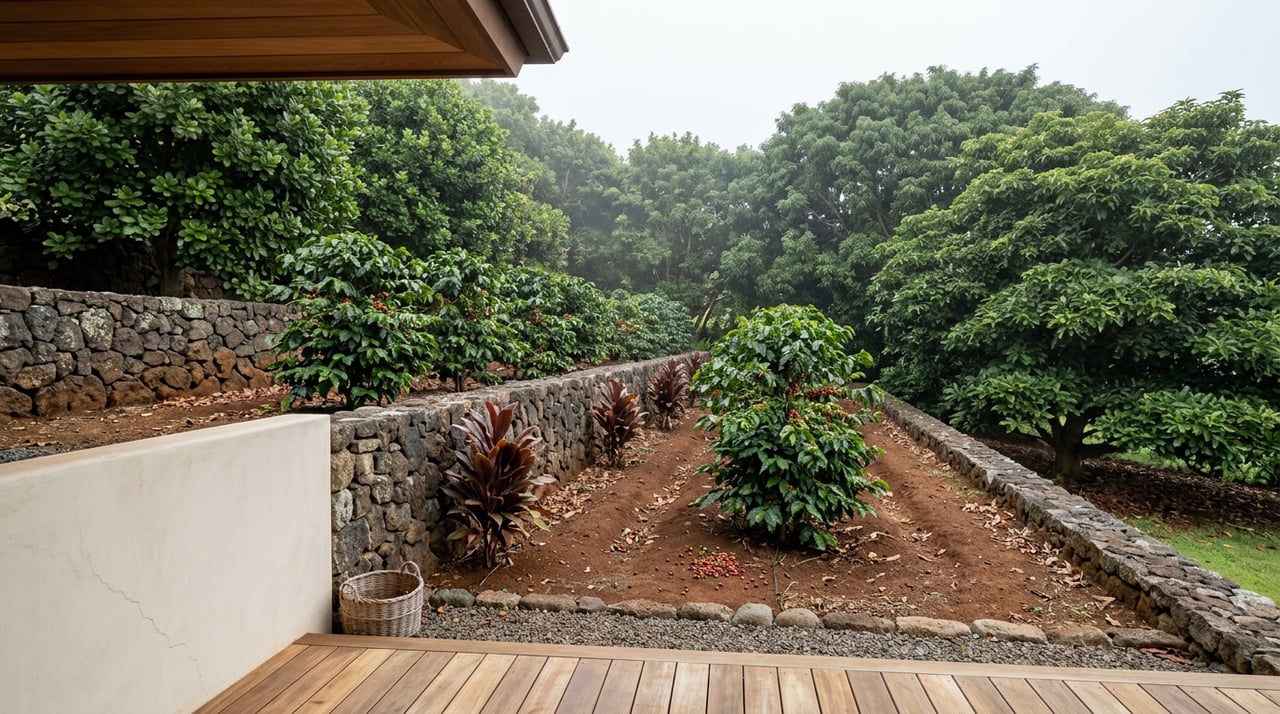
Drive the belt north of Kealakekua and you will find coffee tastings built for tour buses, sample cups poured fast and cheerfully. Kealakekua and Captain Cook are where the harvest itself is still visible as actual work, not staged for a photo.
The Kona Coffee Living History Farm, run by the Kona Historical Society, is the only living history coffee farm in the country, a Smithsonian-affiliated outdoor museum that recreates the working farm of Kona's early Japanese immigrant coffee families rather than a curated tasting room. You walk the same rows a farming family walked a hundred years ago, past the kuriba and hoshidana used to mill and dry the crop.
A few minutes south, Kuaiwi Farm keeps it even smaller. It is a family-run organic operation that requires reservations for tours, and during harvest season the owners sometimes invite small groups to walk the rows with a basket and pick alongside the family, though that offer varies year to year depending on how the harvest is running. That is a different relationship to coffee than a gift shop sample. It is an invitation into someone's actual work.
One November Afternoon, Two Different Coffee Belts
The clearest proof that this neighborhood's economy still runs on the harvest, rather than around it, shows up once a year during the Kona Coffee Cultural Festival, which marks its 56th year this November. On the afternoon the festival's open house crawl works its way down the belt, each town hosts its own set of stops during the same window.
In Kailua-Kona, that stretch of businesses includes Dairy Queen, Ace Hardware, KTA Super Stores, and a handful of coffee shops mixed into an otherwise ordinary retail strip. In Captain Cook and Kealakekua, the same afternoon looks different: the Kona Historical Society, Greenwell Farms, and Hala Tree Coffee anchor the stop, joined by Kona Chips and Caffe Florian. Same festival, same day, same county-wide event calendar, but the businesses hosting it in this neighborhood are the ones whose entire identity is built on coffee and farm production, not general retail that happens to sell a bag of beans by the register.
That contrast is not a coincidence. It reflects what is actually here. Kealakekua and Captain Cook sit in the stretch of the Kona Coffee Belt where the businesses that show up for a coffee festival are, for the most part, the same businesses that would exist whether the festival came through or not.
What This Means If You Live Here
None of this requires a special occasion. The market runs every Sunday whether or not tourists know to look for it. Kuaiwi Farm's rows get picked whether or not a festival is scheduled. The Manago Hotel's dining room fills with the same regulars it has had for years. Living in this stretch of South Kona means the coffee belt is not scenery you drive past on the way to somewhere else. It is the actual economy of the block, visible every single Sunday at Yano Hall and every November when the festival's crawl makes the difference obvious to anyone paying attention.
If this is the kind of neighborhood texture that makes South Kona feel like home to you, and you are curious what a property here is actually worth in today's market, Lovette Llantos can walk you through it. Get Your Free Home Valuation and start the conversation with someone who already knows which Sunday market table has the good avocados.